Requests that providers can act on
Service categories, location or availability, structured request details and clear confirmation. The form should collect enough context for a useful response without making a customer do unnecessary work.
For founders building a two-sided service business
Help customers describe what they need and give the right providers a clear way to respond.
I build the application workflows behind that exchange: customer requests, provider access, API connections and the operator view. My React Native work on Vurks includes lead submission, OTP, provider workflows, REST API integration and Stripe payment screens.
Karachi based / Available remotely to London, UK and US teams
01 Customer journey
02 Provider journey
03 Operator controls
The decision before features
A service marketplace has at least two users with different jobs. One needs to find help or post a request. The other needs enough information to decide whether to respond. Your team needs to see what happened when either side gets stuck.
A focused first release might end with a qualified introduction or accepted quote. Booking, messaging, payments and payouts can follow when the business model requires them. We define that first complete journey before adding features.
What the app may need
These are common parts of a service marketplace, not a promise that every project needs all of them. We select the workflows that let your first users complete the core task.
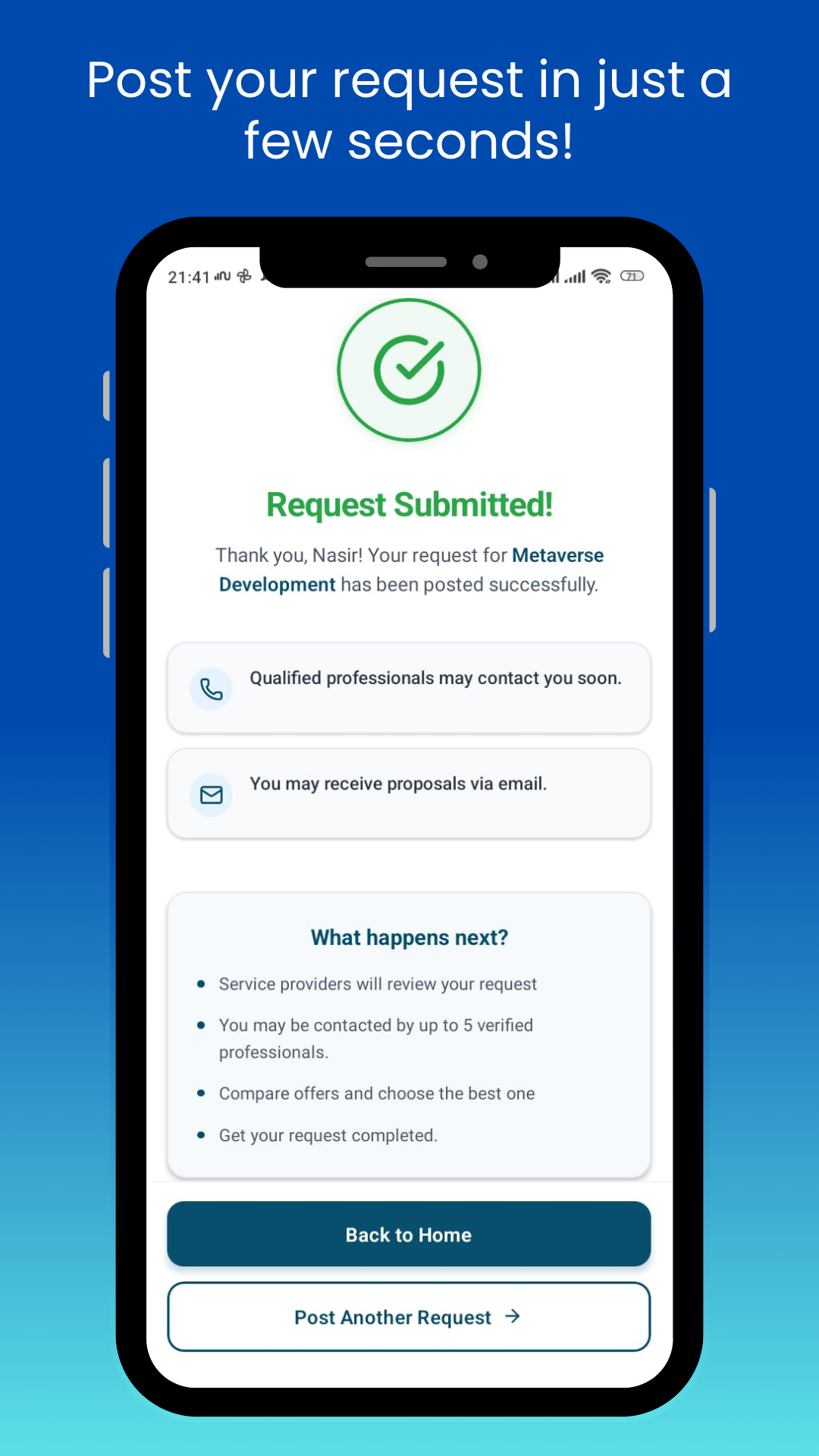
Service categories, location or availability, structured request details and clear confirmation. The form should collect enough context for a useful response without making a customer do unnecessary work.
Account access, profiles, relevant opportunities and a way to respond. Permissions and status changes should be clear to both the provider and your operations team.
Start with transparent service, location and eligibility rules. Manual review may be sensible early on; more automation can follow once you know what makes a match useful.
An admin view for requests, provider status and the handoff between them. Define who can edit, approve or close a record, and what happens when a request cannot be fulfilled.
Notifications, message history or contact handoff can help users continue a job. We choose the simplest communication path that supports the marketplace model and privacy needs.
Charging customers, taking a platform fee and paying providers are different decisions. If your app handles transactions, we review provider onboarding, refunds, disputes and payout responsibilities with the chosen payment provider.
A lead marketplace and a transaction marketplace have different requirements. Stripe's marketplace guide explains why connected accounts, platform fees and payouts need explicit planning when the platform handles payments.
Relevant product work / Vurks
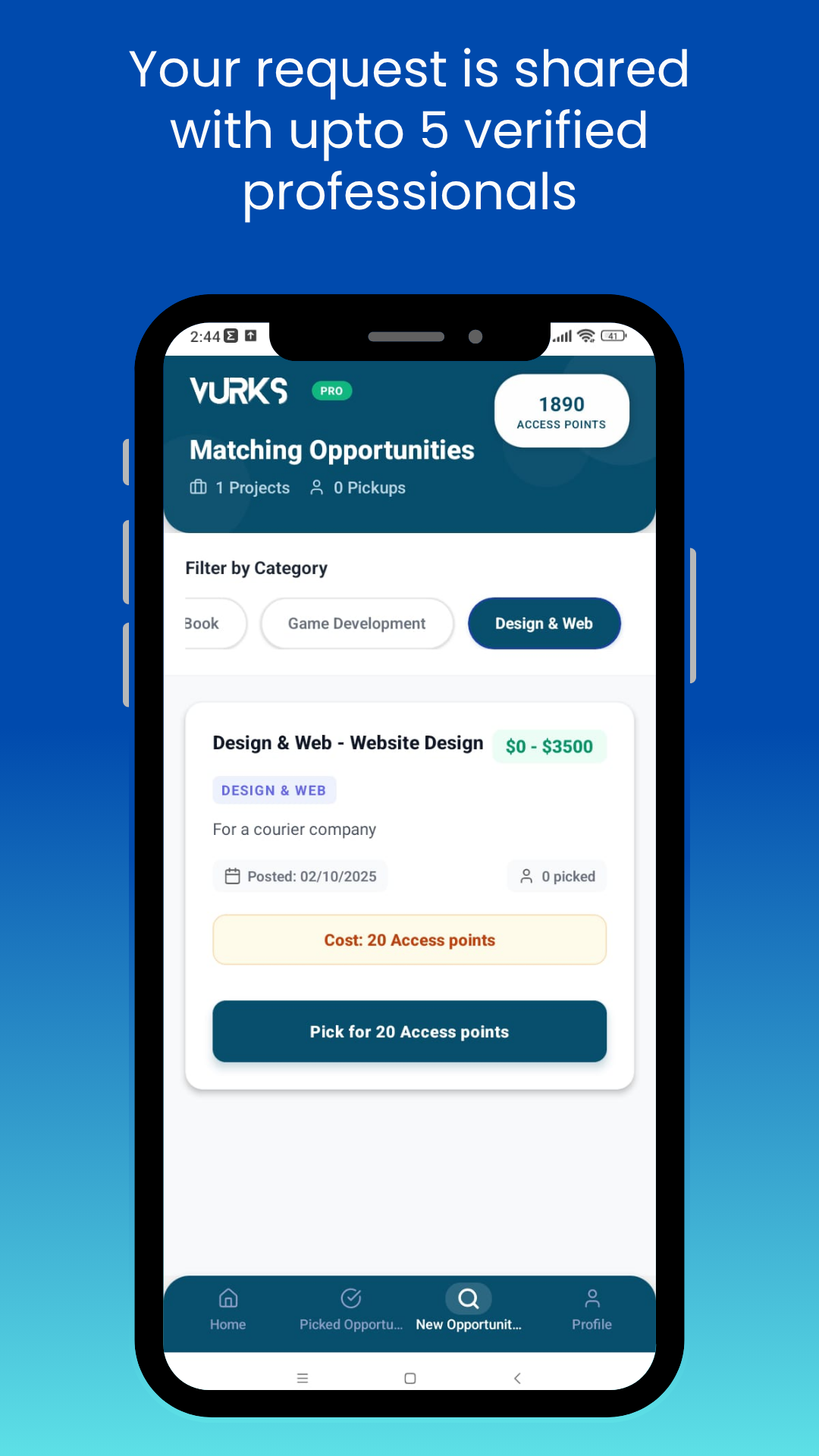
Vurks connects people seeking services with professionals. Its public app and website show the request and provider sides of that model.
My contribution as a full-stack engineer focused on React Native screens and their supporting workflows: lead submission, OTP, provider opportunities, REST API integration and Stripe payment screens. That experience informs how I scope a new app; it does not mean I built every part of Vurks or its payout infrastructure.
I also built authenticated APIs, roles and real-time workflows for ChatKnot, a separate SaaS product. Its case study shows the application work behind those features.
A first release that can be tested
A marketplace needs both sides to participate. We agree what a customer can complete, what a provider can do next and how your team handles exceptions.
Choose the service category, customer need, provider criteria and point where the marketplace creates value.
Decide which screens, roles, integrations and admin actions are required for one complete transaction or introduction.
Connect mobile or web interfaces to application data and APIs. Test the customer, provider and operator paths with realistic examples.
Check onboarding, notifications, failure states and support handoff. Use early requests and provider responses to decide what comes next.
Questions before you commission
These choices affect the build more than a long feature list does.
Start with how customers and providers will actually use the product. A responsive web app may be enough to test the model. Mobile apps can make sense when repeat use, device features or provider work on the move matter. I work with React, Next.js, Node.js and React Native; the platform choice follows the workflow.
At minimum, one customer must be able to submit a useful request, an eligible provider must be able to act on it and your team must be able to see the outcome. The exact screens depend on whether you are selling leads, managing bookings or processing transactions. Ratings, complex matching and multiple service categories can wait if they do not prove the first exchange. Use my marketplace MVP checklist to map the three journeys before commissioning the app.
Yes, if that is part of the agreed scope. Payment collection, platform fees, connected-account onboarding, refunds and payouts need a clear operating model. I can help implement the application integration; your business and payment provider should confirm the commercial and compliance responsibilities before launch. See Stripe Connect's marketplace guidance.
I quote after reviewing the first workflow, platforms, roles, designs, integrations and any existing code. A request-and-introduction product is a different scope from a marketplace that takes payments and manages payouts. Send your first customer and provider journeys, target date and budget range so I can discuss a realistic first release.
Yes. Share the current app, stack, access constraints and the workflow you need to improve. I can review a defined area such as onboarding, provider access, a React Native interface or API integration before proposing work.
I contributed to Vurks, a services marketplace with a public Android app. My documented work includes React Native lead submission, OTP, provider workflows, REST API integration and Stripe payment screens. The linked app and my portfolio experience let you inspect that work in context. I do not present it as a solo build.
Your marketplace idea
Who is the customer? Who provides the service? What should happen after the first request? Tell me what is already designed or built, and the date you are working toward.
A short brief is enough to start. I will reply with questions or a proposed next step.
husnainqureshi134@gmail.com